
Where we start
Pain
Take the edge off.
Manual therapy settles the sore joint and the muscle that has been guarding around it, with ultrasound where it helps, so the joint can be worked without flaring.
What We Treat
You were told it’s arthritis and to learn to live with it. Managing it and surrendering to it are not the same thing, and strength and motion decide how much it actually takes from you.
Sound Familiar?
Two or more? Keep reading.
Why It Happens
Arthritis is wear on a joint surface. The cartilage that cushions the joint thins, the surfaces stop gliding cleanly, and the joint gets stiff and sore. That much is real, and it shows on a scan. Here’s the part nobody tells you: how worn the joint looks is a poor predictor of how much pain you feel or how much you can still do.
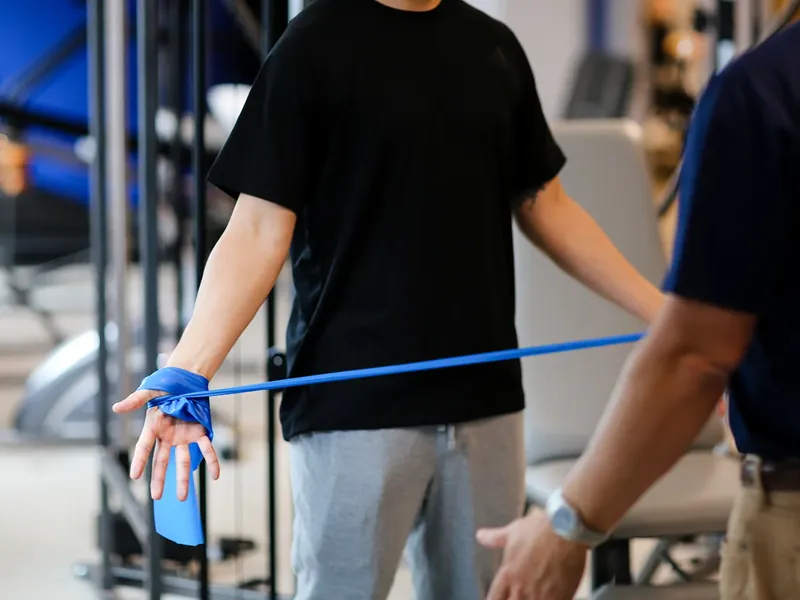
What predicts that is the muscle around the joint, how much motion the joint has kept, and whether the joints above and below are carrying their share. A weak quad makes a worn knee feel every step. A stiff hip quietly pushes its work into that knee. Those three things all change, and changing them is the job. You’re the one everyone else leans on, so “learn to live with it” sounded like the responsible answer. It was never the only one.
The Honest Truth
Nobody regrets starting too early. The list of things you’ve already stopped doing is what waiting costs, and you’re the only one keeping that list.
How We Fix It
Every plan has an endpoint. Here’s what our four-phase program looks like for an arthritic joint.
Where we start
Pain
Manual therapy settles the sore joint and the muscle that has been guarding around it, with ultrasound where it helps, so the joint can be worked without flaring.
Once the pain settles
Prime
Hands-on joint work and graded range exercise recover the motion the joint has been protecting, including in the stiff hip or shoulder that has been pushing extra work into it.
Once motion returns
Perform
Progressive strengthening for the quad, the glute and the grip a worn joint leans on. This is the phase that changes how much arthritis is allowed to limit you.
Before we sign off
Prevent
Stairs, kneeling and carrying get retested under real load, and you leave with the short list of exercises that holds a flare off: that’s the endpoint, not another appointment.
The team approach to care has given me measurable results and the tools I need to address issues with balance and osteoarthritis of the knee. So, thanks Magnolia. I’ll see you soon.
Shared by Sharon O. · Osteoarthritis of the knee
Before: the knee picks your route and your pace
After: you pick the route, and the knee keeps up
Questions, Answered
Usually not. Arthritis shows up on a scan long before it ever hurts, and plenty of people with the same picture have no pain at all, so an image can’t tell you why yours hurts now. A hands-on evaluation can: what moves, what doesn’t, what’s weak, and what’s loading the joint. If a scan would genuinely change your plan, we’ll help you get one. Waiting on one first mostly costs you time.
Yes, and it’s usually the thing that helps most. Hurt and harm aren’t the same here, and resting a stiff joint tends to leave it weaker, so the next thing you ask of it hurts more. What matters is the dose. A licensed physical therapist works out what your joint will take today, then adds to it on purpose, so you’re building the muscle that carries the joint instead of guessing.
You’ll get a straight answer, just not before anyone has looked at the joint. At your evaluation we map the four phases, Pain, Prime, Perform and Prevent, and name what has to be true before you’re done. You’ll always know which phase you’re in and what’s left. That’s a plan with an endpoint, not an open tab of appointments.
Book Your Visit
Request a time and a real person calls you back. No phone tree, no ‘someone will reach out.’ Just a plan.
4.9 · 650+ 5-star reviews
Five short questions. About a minute.
Step 1 of 6
That’s the hard part done. We’ll call during business hours to lock in your time.
Visit Us
Westbank, Marigny, Elmwood. Whichever is closest, you get the same care and the same number to call.