
Where we start
Pain
Calm the pain down.
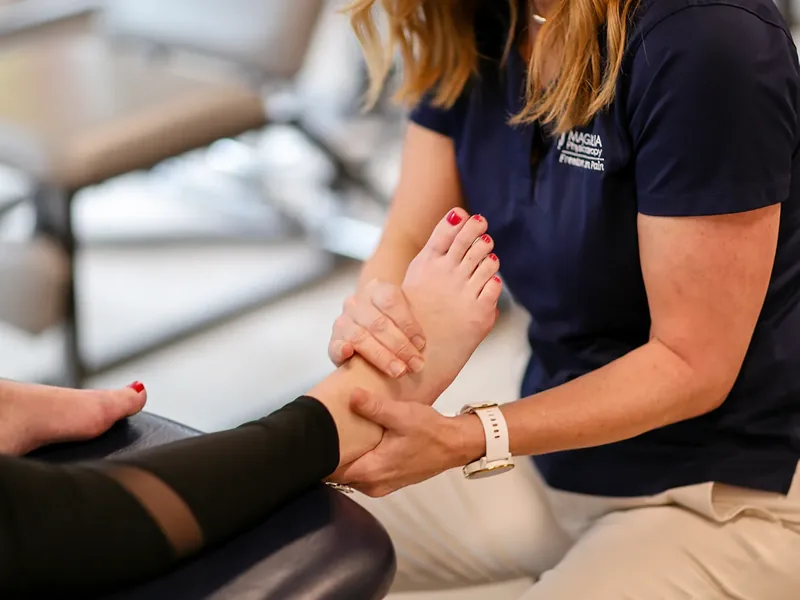
Manual therapy on the ankle and lower leg settles the irritated tissue and the swelling, and where it fits, dry needling releases the calf that’s been guarding it.
What We Treat
An ankle that never felt right again after you rolled it. A heel cord that grabs on the first few strides. A foot that’s been carrying you through eight-hour shifts. A cause-first evaluation finds out which of those you actually have.
Sound Familiar?
Two or more? You’re on your feet all day for everybody else. Which is exactly why your own feet got last pick, and exactly why you’re reading this.
Why It Happens
Your foot hits the ground thousands of times a day, and everything above it depends on that landing being clean. Four things account for most of what we see. Repetitive impact, when running or standing mileage climbs faster than the tendons can keep up with. Foot mechanics, where an arch that sits too high or too low stops absorbing shock and sends the strain sideways into the joints around it. A sprain, where the ankle rolled past its stable range, the ligaments tore, and the balance you lost that week never fully came back. And years of weight bearing wearing cartilage down until the joint stops gliding smoothly.
Which one it is changes the treatment completely. An old sprain that never got rehabbed needs balance and strength, not rest. A mechanics problem needs the mechanics fixed, and no amount of staying off it will do that. A fracture or a surgery needs load added back deliberately, in order. That’s the whole point of a cause-first evaluation: you find out which foot problem you have before anybody treats it.
The Honest Truth
Nobody regrets starting too early. Notice how much of your day you now route around one foot, then decide whether you want another six months of routing.
How We Fix It
Every plan has an endpoint. Here’s what our four-phase program looks like when the problem is below the knee.
Where we start
Pain
Manual therapy on the ankle and lower leg settles the irritated tissue and the swelling, and where it fits, dry needling releases the calf that’s been guarding it.
Once the pain settles
Prime
We restore the ankle motion you lost, especially the bend that lets you get up and over your foot, which is the first thing a sprain, a boot or a cast takes away.
Once motion returns
Perform
Strength and balance, retrained on purpose: standing on one leg, pushing off, walking on uneven ground, and the exact moment your ankle used to give way.
Before we sign off
Prevent
Footwear chosen for your foot, warm-ups that matter, and impact built back in the right order, so the ankle takes what your week asks of it. That’s the endpoint.
A closely monitored therapeutic routine at Magnolia Physical Therapy helped me regain my balance and strength after an ankle fracture and got me walking again unimpaired.
Jorge N. · After an ankle fracture
Then: your foot decided how far you walked
Now: you decide how far you walk
Questions, Answered
For most ongoing foot and ankle pain, no, and waiting on a scan usually just delays the start. There is one exception worth taking seriously: an ankle that swelled and bruised right after a fall or a twist should be examined properly, because a fracture is easy to walk on and easy to miss. We check for that at the evaluation, and if imaging is genuinely called for, we help you get it rather than guess.
Somewhere in between, and that’s the whole skill of it. Staying off the foot entirely weakens the muscles holding your ankle steady, which is what leaves you rolling it again. Pushing through pain that lingers for hours afterward keeps the tissue irritated. A licensed physical therapist works out how much standing, walking and loading your foot can take right now, then moves that line as your ankle earns it.
We won’t put a number on it before we’ve looked at your foot, and anyone who does hasn’t looked. What you get instead is a plan with an endpoint. After the evaluation you’ll know what’s causing the pain, which of the four phases you’re starting in, Pain, Prime, Perform or Prevent, and what has to be true for you to be finished. You’ll always know where you are in that plan and what’s left, instead of booking appointments indefinitely.
Book Your Visit
Request a time and a real person calls you back. No phone tree, no ‘someone will reach out.’ Just a plan.
4.9 · 650+ 5-star reviews
Five short questions. About a minute.
Step 1 of 6
That’s the hard part done. We’ll call during business hours to lock in your time.
Visit Us
Westbank, Marigny, Elmwood. Whichever is closest, you get the same care and the same number to call.