
Where we start
Pain
Calm the pain down.
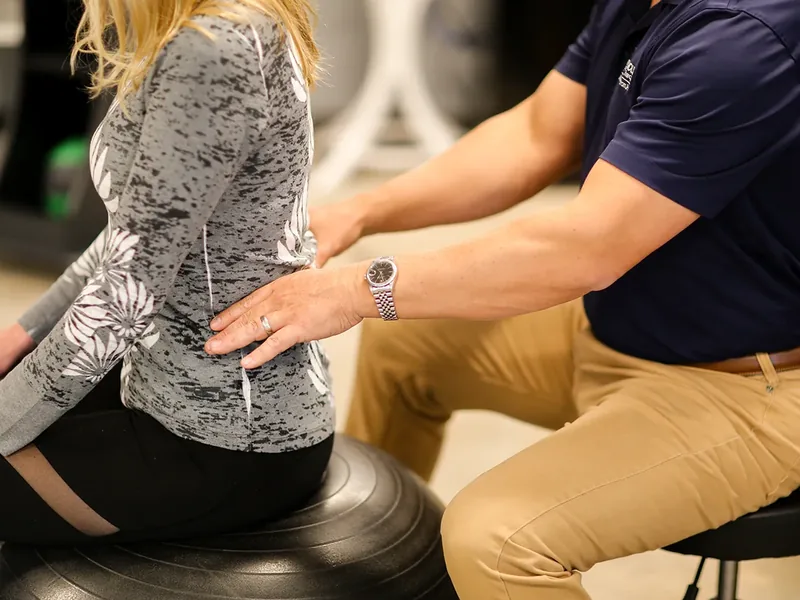
Hands-on work on the trigger points and the stiff segments, with electrical stimulation to quiet the muscle guarding.
What We Treat
The stiffness getting out of the car. The electric line that runs from your lower back into your foot. It starts with a cause-first evaluation, not a guess.
Sound Familiar?
Two or more? Keep reading.
Why It Happens
Your back doesn’t hurt for no reason, and it’s rarely one thing. Four culprits show up most. A disc that has bulged just far enough to press on a nerve, which is what sends pain down your leg. The small facet joints linking your vertebrae, stiff and inflamed until they stop sharing the load. Trigger points: muscle that overworked, spasmed, and stayed hard. And the sciatic nerve itself, held under tension from your lower back all the way to your calf.
Then there is the rest of your day. Long stretches sitting on a hard seat. One forceful twist to shift something heavy. Even a thick wallet in a back pocket. None of that started this on its own, but it keeps reloading the same spot before it heals. Sorting out which culprit is actually driving your pain is what a cause-first evaluation is for. You’re the one everybody calls when something needs lifting. Which is exactly why your own back is last on the list, and exactly why you’re reading this.
The Honest Truth
Nobody regrets starting too early. Look at what you’ve already stopped doing, and ask what’s next on that list.
How We Fix It
This is Magnolia’s own four-phase program, run for back pain and sciatica. Every plan has an endpoint.
Where we start
Pain
Hands-on work on the trigger points and the stiff segments, with electrical stimulation to quiet the muscle guarding.
Once the pain settles
Prime
Joint and nerve mobility work restores bending and twisting. Massage therapy loosens the tissue holding the pattern in place.
Once motion returns
Perform
Progressive core and hip strengthening builds the support your spine was missing before the first flare-up.
Before we sign off
Prevent
Lifting, bending and twisting get tested under real load, and we fix how you sit and pace your day. That’s the endpoint, not another appointment.
I wanted to go after the cause and not just treat symptoms. I was quite happy that Magnolia agreed to help me.
Curt M.
At the start: the pain picks what you can do
At the end: you pick what you can do
Questions, Answered
Usually not, and it’s rarely the first step. A scan shows structure, not what is loading it. Bulges and wear turn up on scans of people who have no pain at all, so a picture on its own doesn’t tell you why your back hurts. We start with a hands-on, cause-first evaluation. If imaging would genuinely change your plan, we’ll help you get it. Waiting on a scan is not the same as starting.
Yes, and movement usually helps more than rest. Hurt doesn’t always mean harm, and lying still tends to leave you stiffer and weaker, which sets up the next flare-up. What matters is dosing the right movement for your cause, and knowing which movements to leave alone for now. That is what a licensed physical therapist works out at your evaluation, then progresses as you improve.
We won’t hand you a number before we have looked at your back, because a number picked in advance is a guess. What you get instead is a plan with an endpoint. Your plan runs through our four phases, Pain, Prime, Perform and Prevent, and each phase has a job and a way to know you have finished it. Your therapist talks through the likely shape of yours at the evaluation, and you will always know which phase you are in and what is left.
Book Your Visit
Request a time and a real person calls you back. No phone tree, no ‘someone will reach out.’ Just a plan.
4.9 · 650+ 5-star reviews
Five short questions. About a minute.
Step 1 of 6
That’s the hard part done. We’ll call during business hours to lock in your time.
Visit Us
Westbank, Marigny, Elmwood. Whichever is closest, you get the same care and the same number to call.