
Where we start
Pain
Calm the tendon down.
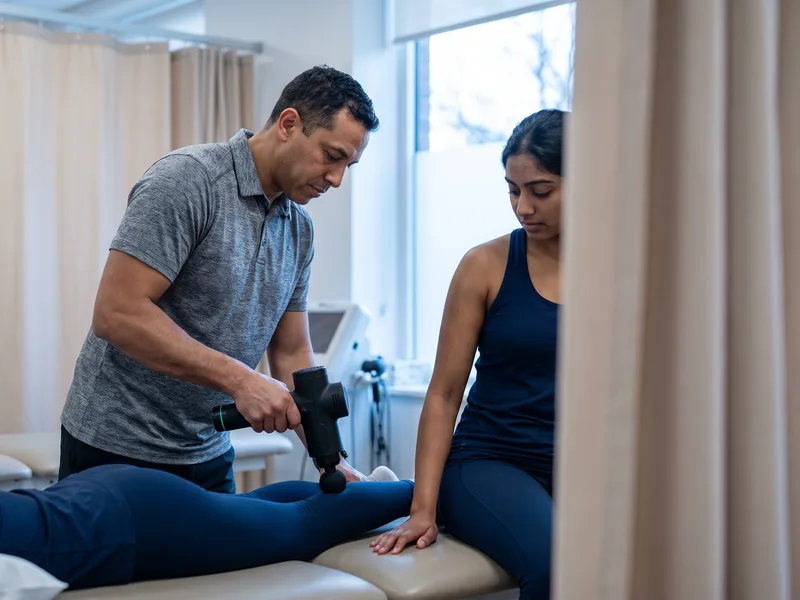
Ultrasound therapy and gentle hands-on techniques bring the irritation, the swelling and the tenderness down.
What We Treat
Shoulder, elbow, knee or heel: it calms down with rest, then flares the moment you go back to normal. We go after what overloaded it.
Sound Familiar?
Two or more? Keep reading.
Why It Happens
A tendon is the thick, fibrous cord that ties muscle to bone. Tendinitis is that cord irritated and inflamed, usually from doing one thing too many times, sometimes from a single hard effort. Shoulders, elbows, wrists, knees and heels get it most. Underneath the irritation are microscopic tears, which is why the pain, the swelling and the stiffness all arrive together.
The overuse is the trigger. The reason is usually somewhere else: a muscle that isn’t pulling its share, a joint that stopped moving, a posture that changes the angle of the pull. That’s why rest works and then stops working. Rest calms the tendon down. It doesn’t change what was overloading the tendon, so going back to normal puts you straight back where you were. A cause-first evaluation goes looking for the overload, not just the sore spot. You’re the one who keeps showing up: for the team, for the job, for the family. Nobody gets tendinitis from sitting still, and nobody fixes it by sitting still either.
The Honest Truth
Nobody regrets starting too early. Ask yourself how many more rest-and-flare cycles you want to spend before something actually changes.
How We Fix It
This is Magnolia’s own four-phase program, run for tendinitis. Every plan has an endpoint.
Where we start
Pain
Ultrasound therapy and gentle hands-on techniques bring the irritation, the swelling and the tenderness down.
Once the pain settles
Prime
Manual therapy and targeted stretches increase blood flow, break up scar tissue and free the tissue around the tendon.
Once motion returns
Perform
Eccentric exercise, the slow lowering work that actually rebuilds tendon, plus strengthening for the imbalance that overloaded it.
Before we sign off
Prevent
A graded return to your activity, the postural and mechanical corrections that stop the recurrence, and a home program you keep. That’s the endpoint, not another appointment.
I'm nearly pain free and have dramatically increased my strength. I'm very happy with the team effort from Magnolia and the care they've given me. Highly recommend.
Jeremy R.
At the start: the flare-up decides what you can do
At the end: you decide what you can do
Questions, Answered
Usually not. Tendinitis is worked out mostly by hand and by history: where it is tender along the tendon, what loads it, what calms it down. A scan rarely changes the early part of the plan. We start with a cause-first evaluation to find what has been overloading the tendon, and we use ultrasound therapy on the tendon itself as part of treatment. If imaging would genuinely change your plan, we’ll help you get it.
Yes, and loading the tendon is how it heals. Complete rest feels better and leaves the tendon just as intolerant as it was. What matters is which movements, how heavy and how slow. Eccentric work, the controlled lowering half of a lift, is the piece that rebuilds tendon. Some aggravating activities do need to pause for a while. A licensed physical therapist sorts that out at your evaluation, then progresses you as the tendon tolerates more.
We won’t hand you a number before we have looked at the tendon, because a number picked in advance is a guess. What you get instead is a plan with an endpoint. Your plan runs through our four phases, Pain, Prime, Perform and Prevent, and each phase has a job and a way to know you have finished it. Your therapist talks through the likely shape of yours at the evaluation, and you will always know which phase you are in and what is left.
Book Your Visit
Request a time and a real person calls you back. No phone tree, no ‘someone will reach out.’ Just a plan.
4.9 · 650+ 5-star reviews
Five short questions. About a minute.
Step 1 of 6
That’s the hard part done. We’ll call during business hours to lock in your time.
Visit Us
Westbank, Marigny, Elmwood. Whichever is closest, you get the same care and the same number to call.