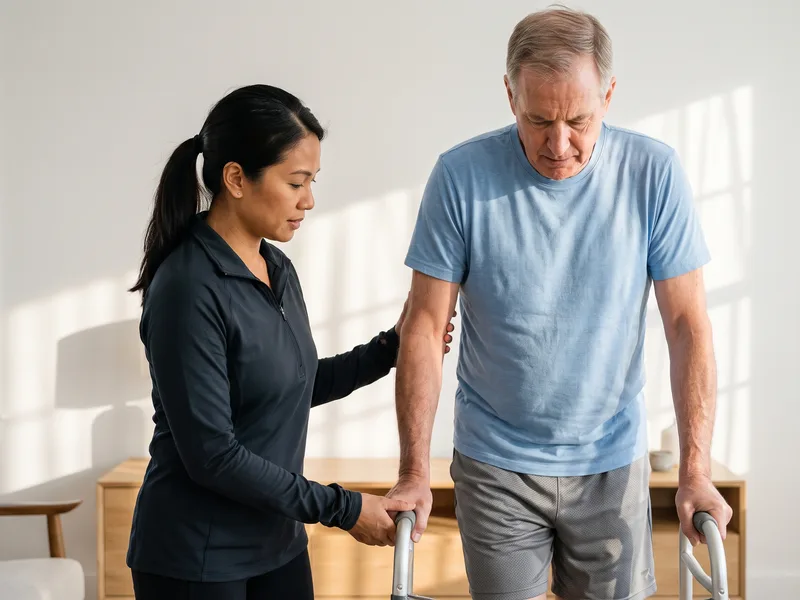
Parkinson’s affects the part of the brain that runs movement in the background, without being asked. The instructions still get sent. They just arrive smaller than you intended them. That’s why the stride shortens, the arm swing fades, the handwriting shrinks, and why ordinary movement starts to feel like a task: your body is scaling things down without consulting you.
Physical therapy does not act on the disease itself. That belongs to your neurologist and your medication. What therapy works on is everything downstream: the size of your steps, range in your hips and shoulders, leg strength, how you turn, how you get out of a chair, and the cues that get your feet going again when they stall. Those are trainable, and training them is what improves movement, balance and confidence. It also works against the stiffness and lost strength that come from simply moving less, which often cost more day to day than people expect.