What We Treat

Balance and gait disorder treatment in New Orleans.

Reaching for the wall on the way down the hall. Reading the floor before you move. Steadiness is trainable, and it starts with a cause-first evaluation, not a guess.

Unsteady walking Slower turns Dizzy spells Talk to a Specialist

Sound Familiar?

Does this sound like you?

  • Reaching for the wall or the rail on the way down the stairs
  • Turning more slowly than you used to, and planning the turn before you make it
  • Checking the floor before you move, reading it for the rug, the cord, the step
  • Standing up from a low chair and waiting a beat before you trust your legs
  • Reaching up to a high cabinet and feeling the room shift for a second
  • Taking the long, even route because the shortcut has a curb and a gravel patch

Any of these sound familiar? Keep reading.

Why It Happens

Balance & Gait Disorders have a cause. We find it.

Staying steady is not one skill. It’s three sources of information agreeing with each other: your inner ear, your eyes, and the sensation coming up from your feet, ankles and hips. Your muscles then have to react fast enough to act on what they report. When one of those sources goes quiet, the others quietly cover for it. When two do, walking starts to take real attention, and attention is a limited thing.

Which means the reason is different for different people. It can be the inner ear. It can be nerves in the feet that no longer report position clearly. It can be legs that lost strength through a slower stretch of life. It can be a neurological condition like Parkinson’s or a stroke changing how the signal gets through. It can be a medication with a side effect nobody flagged. A cause-first evaluation is how we find out which of those is costing you the most, because the training that helps is different in each case.

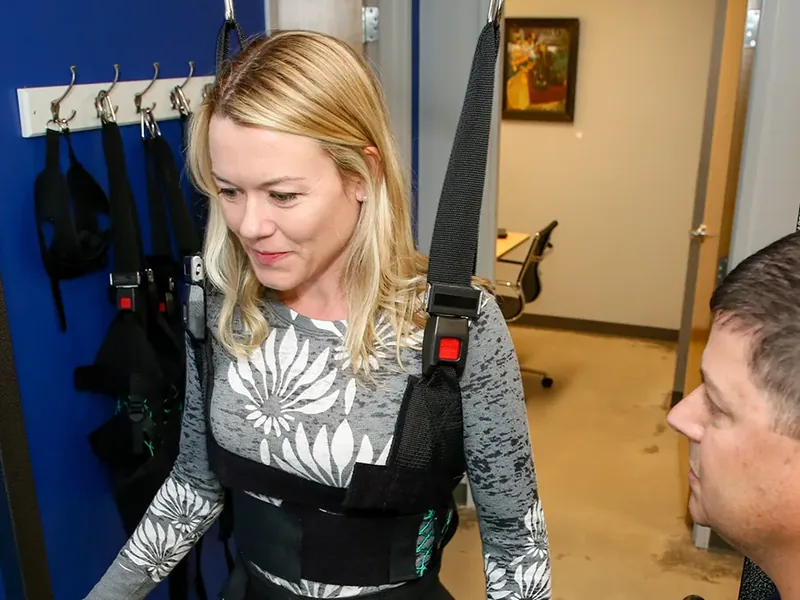
Patient supported by an overhead harness while a therapist stays alongside her for balance and walking practice

The Honest Truth

The list gets shorter before anyone mentions it.

If you keep waiting

  • The evening walk gets shorter, then gets skipped, and nobody says a word about it
  • You start choosing where to sit by how easy it will be to get back up
  • Moving less makes you weaker, and being weaker makes moving harder: the balance systems you stop using are the ones that fade

If you start now

  • You leave the first visit knowing what is costing you your steadiness
  • You train it one-on-one with a licensed physical therapist, with a hand and a rail right there
  • You get a plan with an endpoint, and you know which phase you are in

Nobody regrets starting too early.

How We Fix It

Our four phases. Built around your steadiness.

Every plan has an endpoint. Here’s what our four-phase recovery program looks like for balance and gait, one-on-one with a licensed physical therapist, every visit.

Where we start

Pain

Settle the symptoms. Get a baseline.

Unsteadiness often arrives without pain. If something does hurt, or the room spins, hands-on work and positioning settle that first. The real job of phase one is measurement: how you walk, how you turn, how your legs behave getting out of a chair.

Once the pain settles

Prime

Get the motion and the signal back.

Stiff ankles and hips get their range back, because a foot that cannot adjust cannot correct you. Then we retrain the information your feet and inner ear send up, which is what your balance reactions run on.

Once motion returns

Perform

Make it strong enough to trust.

Strength where steadiness actually comes from: ankles, quads, hips. Then we add the hard parts back a layer at a time, head turns, changes of direction, carrying something, uneven ground, with support right there while you learn them.

Before we sign off

Prevent

Keep it, on your own.

You go home with the drills that hold what you built, a look at the rug and the lighting and the shower, and the right walking aid if you decide you want one. That’s the endpoint, not another appointment.

My movement and balance are very much improved. I no longer need a cane to walk!

Galen B.

Where we start: the floor gets read before every step

What we work toward: eyes up, and the step just happens

Balance & Gait Disorders Phase by phase

Questions, Answered

What people ask before booking for balance and gait disorders.

Usually not. A scan shows structure, and unsteadiness is mostly about how systems are working together, which an image cannot show. What does help is what you already have: any notes from your doctor, and your current medication list, because a few common medications affect balance. Then we watch you walk, turn and stand up, and test the systems steadiness runs on. If imaging ever becomes genuinely necessary, we’ll help you get it.

In most cases movement is the treatment rather than the risk. The systems that keep you upright stay sharp by being used, so doing less tends to leave you less steady, not more. The difference in doing it here is supervision: a licensed physical therapist sets the challenge at a level you can hold, with support within reach, and adds difficulty only once the last step is solid.

That depends on what we find, and we would rather say so than invent a number before we have watched you move. What you get instead of a guess is a plan with an endpoint: our four phases, Pain, Prime, Perform and Prevent, with the goals for each one written down. You will always know which phase you are in and what is left, and we reassess as we go rather than booking an open-ended run of appointments.

Book Your Visit

Ready when you are.

Request a time and a real person calls you back. No phone tree, no ‘someone will reach out.’ Just a plan.

  • Hours Mon to Fri, 7:00am to 6:00pm
  • (504) 733-0254 Prefer to talk now? Call us.
  • Insurance benefits check before you book

4.9 · 650+ 5-star reviews

Five short questions. About a minute.

Step 1 of 6

So we know who to look for when you walk in.

Visit Us

Three clinics. One phone number.

Westbank, Marigny, Elmwood. Whichever is closest, you get the same care and the same number to call.